Understanding U.S. Tariff Categories
Find Recent Updates Regarding Tariffs & FAQs on our U.S. Shipping Updates Blog
When shipping to the United States, there are four main tariff categories you should be aware of. Any products that are not CUSMA (Canada-United States-Mexico Agreement)-approved may be subject to the following tariff fees: base tariffs, Section 232, Section 301, and Section 338.
Note: Products classified as informational materials (magazines, books, CDs, vinyls, etc) are currently exempt from tariffs and can be shipped to the U.S. duty-free. This does not apply to Section 301 tariffs (with certain exceptions such as children’s books, some posters and prints, etc).
To make each category easier to understand, we’ve broken them down in the sections below.
Base Tariffs
With the removal of de minimis entry, which previously allowed shipments valued under USD $800 to enter the United States duty-free, all shipments and products must now follow the requirements outlined in the official U.S. Harmonized Tariff Schedule website.
From telephones, to textbooks, to water bottles, every single product is assigned an HTS (Harmonized Tariff Schedule) code, which is used to classify goods being imported into the U.S.
This ten-digit code:
- Determines the product’s base duty rate
- Indicates whether it qualifies under any trade agreements
- Ensures accurate and compliant customs reporting.
Learn more about HTS codes here.
In simple terms, the base tariff rate is determined by the HTS code assigned to a product, based on the guidance outlined in the official HTS schedule. If a product does not qualify for any special programs, the base tariff is typically calculated as a percentage of the product’s declared value. In some cases, however, it may instead be assessed based on the weight of the goods.

This is why it’s important to review the product’s HTS code on the official HTS website to clearly understand how the base tariff rate will be calculated.
Section 232 Tariffs
Also known as the metal tariff, this category applies to products containing iron, aluminum, copper, or steel. Originating from Section 232 of the Trade Expansion Act of 1962, it applies to HTS codes classified as being made from these metallic materials.
At the moment, other metals such as titanium and platinum are not included in this category.
The primary goal of Section 232 tariffs is to protect the metal and automotive industries. However, they can also affect other products, such as cookware and sewing needles. Products subject to Section 232 tariffs are still subject to base tariffs.
⚠️It’s important to note that CUSMA does not exempt products from Section 232 tariffs. Even if a product is CUSMA-approved, any applicable Section 232 fees must still be paid.
The Section 232 tariff can be calculated differently depending on the product and the guidance provided by U.S. authorities. Determined by the product’s HTS code, the tariff may be:
- Calculated based on the metal content of the item
- Assessed as a flat rate based on the total value of the product, regardless of its metal content; this is typically shown as Section 232 (Static) for tariff breakdowns.
For a full list of affected HTS codes, visit our comprehensive list.
Section 301 Tariffs
Section 301 originates from the Trade Act of 1974. Its purpose is to apply pressure on countries that the U.S. administration considers to be engaging in discriminatory or unfair trade practices.
Currently, Section 301 tariffs apply to products made (country of origin) in the 60 affected economies mentioned by the U.S. administration.
The additional duty rate varies depending on the country of origin.
The following countries of origin are subject to a 10% duty, in addition to any other applicable duties, as they have met certain requests and trade objectives established by the U.S. administration:
- Argentina
- Bangladesh
- Cambodia
- Canada
- Ecuador
- El Salvador
- Certain products of the European Union (all 27 member states)
- Guatemala
- Honduras
- India
- Indonesia
- Jordan
- Malaysia
- Mexico
- Pakistan
- Sri Lanka
- United Kingdom
- Certain products of Taiwan
- Trinidad and Tobago
All other countries of origin that the U.S. is currently investigating will be subject instead to a 12.5% duty, in addition to any applicable duties.
Exception:
Certain products originating from Brazil are subject to a 25% duty under Section 301.
This tariff applies to all HTS codes from chapter 1 through 97, with some exclusions. You can view the full list of excluded HTS codes here.
New Section 338 Tariffs Announced for Select Industries
The U.S. government has announced a new tariff category, Section 338, that is expected to take effect on August 19. This additional import charge will apply to products from certain Canadian industries that the U.S. has identified as having unfair trade practices.
For now, the tariffs are expected to affect industries such as motor vehicles, alcohol, and dairy, with additional products of other industries affected.
If applicable, products will be subject to an additional 50% duty, in addition to any other duties, tariffs, or fees that may already apply.
Below is a list of the most commonly used HTS codes that will be affected by this upcoming change:
| Subheadings | Description |
| 3919.90.50 | Self-adhesive plates, sheets and other flat shapes, of plastics |
| 3926.40.00 | Statuettes and other ornamental articles, of plastics |
| 7117.19.90 | Imitation jewelry of base metal |
| 3926.90.99 | Other articles of plastic |
| 9503.00.00 | Toys, including riding toys other than bicycles; puzzles; reduced-scale models |
| 7113.11.50 | Silver articles of jewelry and parts thereof |
| 3304.30.00 | Manicure or pedicure preparations |
| 4820.10.20 | Diaries, notebooks and address books, bound; letter and memorandum pads and similar articles, of paper or paperboard |
| 3926.10.00 | Office or school supplies, of plastics |
| 4911.91.40 | Pictures, designs and photographs, excluding lithographs on paper or paperboard, printed not over 20 years at time of importation |
Important:
CUSMA preferential treatment does not apply to affected HTS codes for this tariff category when the country of origin is Canada. However, if the country of origin for the affected HTS code is the United States or Mexico, CUSMA preferential treatment will continue to apply.
Our team is reviewing these changes to understand how they may affect our clients. We know keeping up with tariff updates can feel overwhelming, so we’re closely monitoring developments and will continue to share clear, practical guidance to help you ship with confidence.
How Can Chit Chats Help?
Thinking about shipping to the U.S. with all these tariffs? Simplify the process with Chit Chats, your low-cost shipping solution. With just the HTS code and country of origin, we can accurately estimate the duties that apply to your shipments and products.
Our easy-to-use platform lets you calculate duties upfront, helping you avoid unexpected charges for your customers. With efficient customs clearance, your U.S. shipments move smoothly from border to doorstep.
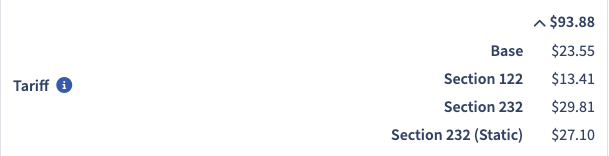
With us, you keep more of your profits with some of the lowest customs and broker processing fees compared to other carriers. Ship to the U.S. with Chit Chats today and start saving!
Start saving with Chit Chats today!
No hidden monthly fees. Unbeatable prices. More than 20 million packages delivered.